New Mexico Early Learning Standards
New Mexico’s Early Learning Standards (ELS) are now available in English and Spanish. The ELS are a developmental framework describing what children from birth through age five know and are able to do. Shaped by community input and current child development research, they replace the Early Learning Guidelines and provide a shared language across ages, programs, and settings.
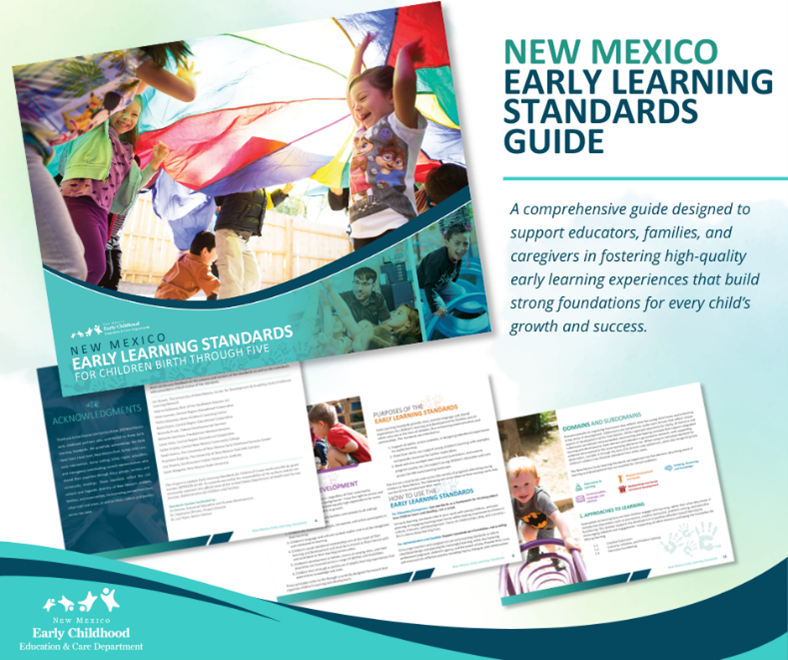
Download the Early Learning Standards

About the Standards
The New Mexico Early Learning Standards are organized into five domains describing areas of learning and development that are essential for school readiness:
Approaches to Learning
Approaches to learning focus on how children engage with learning, rather than what they know. It includes key dispositions such as persistence, creative expression, problem-solving, and executive functioning. This domain supports the development of positive attitudes toward learning by encouraging initiative and engagement—supporting all other domains and laying the foundation for lifelong learning.
Communication, Language, and Literacy
Communication, language, and literacy as a domain emphasizes young children’s ability to understand and use language to express thoughts, ideas, and needs. It includes listening, understanding, speaking and communication skills, vocabulary growth, comprehension, early reading and writing, and the use of multiple forms of communication. This domain supports children in building relationships, participating in their social contexts, and becoming confident, capable communicators and emergent readers and writers. Furthermore, this domain supports the development of multilingualism and recognizes the valuable linguistic resources that children from diverse language backgrounds bring to their learning environments while supporting communication, language, and literacy in multiple languages and modes.
Physical Development and Health
Physical development and health focuses on children’s growing ability to move their bodies, care for themselves, and make healthy choices. It includes large and fine motor skills, sensory development and integration, self-care routines, nutrition, safety, and physical activity. This domain supports overall well-being by promoting strength, coordination, independence, and skills that contribute to a healthy lifestyle.
Relationships and Social Emotional Development
Relationships and social emotional development center on how children understand and manage emotions, form secure relationships, and navigate social interactions. It includes self-awareness, self-regulation, empathy, cooperation, and the ability to build positive connections with adults and other children. The skills developed in this domain promote identity formation, mental health and resilience, as well as a sense of belonging in family and community.
Thinking, Reasoning, and Knowledge
Thinking, reasoning, and knowledge emphasize how young children make sense of the world through exploration, inquiry, and problem-solving. It includes cognitive skills such as memory, attention, reasoning, and early concepts in math, science, technology, and engineering. Skills within this domain support children in developing curiosity, critical thinking, and a foundation for later learning by encouraging them to ask questions, make connections, and construct knowledge through active engagement.
The indicators for each domain and their subdomains are organized into four progression bands, with approximate age ranges from birth through age five, which describe typical characteristics of early childhood development:
- Beginning Awareness and Connections (infancy through young toddler: 0–18 months)
- Building Competence with People and Environment (older toddlers through 2-year-olds: 16–30 months)
- Deepening and Stretching (preschool: 28–45 months)
- Applying and Extending (PreK turning 4 to age 5: 42–60 months)
Age ranges overlap intentionally, reflecting natural variation in children’s development.
While organized separately for clarity, all domains and subdomains are deeply interconnected, representing overlapping concepts that support integrated learning and development.
A Developmental Framework
The Early Learning Standards are a developmental framework that provides a shared language for understanding children’s learning. They are not a curriculum, a checklist, or a formal assessment, and they work alongside the curriculum and assessment tools each program already uses. The New Mexico Early Learning Standards represent research on child development and integrate the state’s diverse cultures and geography. They include examples and vignettes that show how development might look in practice.
If You Have Concerns About a Child’s Development
All children grow and develop at their own pace. Age ranges are included as a reference point, and if there are concerns about a child’s development, there are other tools to support screening, assessment, and intervention.
- Birth to age 3: If you or your child’s doctor, child care professional, or other provider are concerned about your child’s development, you can make a referral to the Family Infant Toddler (FIT) Program. Learn more about FIT
- Ages 3 to 5: If you suspect your child has a delay or disability, contact your local school district. Learn more about early childhood special education
For Families
Families are children’s first teachers and know their children best. Standards help guide what children may learn, but every child grows in their own way.
While some families may choose to engage with the standards document, others may resonate more with the Family Guide.
New Mexico’s Early Learning Standards: A Family Guide to Understanding and Supporting Your Child’s Development
The Family Guide introduces families and caregivers to the Early Learning Standards. It gives an accessible overview of the five domains and four developmental progressions and reflects New Mexico’s cultural, linguistic, and geographic diversity. It is not a checklist or a measure of a child’s progress. Instead, it offers practical, everyday ways to support learning at home and partner with educators and programs.
Download New Mexico’s Early Learning Standards: A Family Guide to Understanding and Supporting Your Child’s Development
For Early Childhood Professionals
The Early Learning Standards are a tool to be used across the variety of programs educating young children in New Mexico.
- Educators and caregivers: Use standards as a framework for thinking about how children learn and develop, not a script.
- Administrators and coaches: Support standards as a foundation, not a ceiling.
- Home visitors and development specialists (early intervention): Use standards as a bridge to connect your specialized work with the broader community of adults supporting each child.
Coaches are the primary resource for professionals putting the ELS into practice. Coaches are using the ELS to support providers in their planning, observation, and family communication, with consistent guidance across regions. Coaching support is available through FOCUS and New Mexico PreK.
Your coach can help you use the ELS as a developmental lens to observe, plan, and communicate about children’s growth. The ELS are something to know and use to strengthen teaching, not another task to complete.
Professional Learning
The standards are just the beginning. ECECD and partners are developing implementation tools to help you put the ELS into practice in your setting. Information about professional learning on the standards, delivered through New Mexico’s statewide training system, will be posted here as it becomes available.