
2026 Legislative Session: Stronger Child Care for Every New Mexico Family
The 2026 legislative session was a historic moment for early childhood in New Mexico. Lawmakers passed landmark legislation to cement Universal Child Care in state law and remove barriers that have limited child care access in communities across the state. This page summarizes what passed during the legislative session, what it means for families and providers, and links to key resources from the session.

Universal Child Care
New Mexico made history on November 1, 2025 when it became the first state in the nation to offer Universal Child Care — providing no-cost child care assistance to families who work or attend school, regardless of income. By removing income limits and copayments, Universal Child Care saves families an average of $12,000 per child per year in out-of-pocket costs.
The 2026 legislative session solidified this achievement by codifying the program in state law and securing its long-term fiscal sustainability.
Read more about Universal Child Care, including testimonials, current data, and frequently asked questions, on the Universal Child Care webpage.
Start your application for Universal Child Care through the Am I Eligible? online application.
2026 Legislative Outcomes
PASSED! Senate Bill 241 — Child Care Assistance Program Act
What It Does
Senate Bill 241 (SB 241) puts New Mexico’s Child Care Assistance Program into state law, giving Universal Child Care a permanent legal foundation. Among other requirements, the law:
- Provides long-term, sustainable funding by allowing the legislature to appropriate up to $700 million from the Early Childhood Trust Fund over the next five years—providing certainty for families and providers that allows them to plan and expand their businesses.
- Ensures that all families working or in school, grandparents raising grandchildren, foster parents, and at-risk families always qualify for universal child care.
- Sets guardrails to protect the money needed for universal child care in times of economic uncertainty. These safeguards include copayments for higher income families and/or a prioritized waitlist, ensuring the program remains both sustainable and equitable.
- Waives copayments for families with annual household incomes at or below 600% Federal Poverty Level (FPL) and sets requirements if ECECD must implement copayments, including a 90-day notice to families and a sliding scale for higher-income households.
- Requires the use of a cost estimation model to inform provider reimbursement rates, anchoring funding decisions in evidence-based rates that reflect the true cost of delivering quality care, including adequate wages for child care staff.
- Requires new annual program reporting to strengthen transparency, oversight, and program accountability.
Why It Matters
By anchoring it in law, SB 241 protects New Mexico families’ access to child care assistance in the long term and creates a transparent, accountable framework for how the program will work. Now, families and child care providers can plan with confidence that universal child care will be here for them into the future.
Implementation
SB 241 was signed by Governor Michelle Lujan Grisham on March 10, 2026, and goes into effect May 20, 2026.
ECECD is preparing amendments to the Child Care Assistance regulations at 8.9.3 NMAC to implement new program requirements established in SB 241 and will release details soon. Check the Regulation Changes webpage for the latest updates on the regulatory process.
For more information on SB 241, check out the Child Care Assistance Program Act At-a-Glance
Click here to view the SB 241 Questions and Answers Flyer
PASSED! Senate Bill 96 — Regulated Child Care Zoning Requirements
What It Does
Senate Bill 96 (SB 96) supports child care supply building efforts and improves access to quality care for families by making it easier to open child care in neighborhoods and high-density areas. The law:
- Provides statewide consistency in land use for child care homes and centers, ensuring that the rules are the same no matter where you live in the state.
- Requires local authorities, like counties and cities, to treat licensed and registered child care homes the same as regular homes under local zoning codes.
- Prohibits local authorities from imposing extra restrictions on child care homes, like special fees, permits or additional off-street parking.
- Prohibits homeowners’ associations from banning child care homes from operating in their jurisdictions
- Allows licensed child care centers to operate in commercial areas, mixed-use neighborhoods, and multi-family residential zones, like apartment complexes.
Why It Matters
Families benefit when child care is close to where they live, work, and go to school. However, for many years local zoning restrictions have made it extremely difficult for child care providers to operate in neighborhoods and high-density areas—intensifying child care deserts, or areas of the state where demand for care outpaces available slots. By making it simple and consistent to open child care across the state, SB 96 helps to build a care supply that meets families where they are.
Implementation
SB 96 was signed by Governor Michelle Lujan Grisham on March 10, 2026, and goes into effect July 1, 2026.
ECECD is working with the Low Income Investment Fund to provide assistance to cities, counties, homeowners’ associations, and child care providers who need to understand the requirements in SB 96. Click on each fact sheet below to read more about what SB 96 may mean for you.
View the SB 96 Fact Sheet for Cities and Counties in English and Espanol Here
View the SB 96 Fact Sheet for Homeowners’ Associations in English and Espanol Here
View the SB 96 Fact Sheet for Child Care Providers in English and Espanol Here
View the SB96 Zoning Requirements Guidance Resource in English and Spanish Here
View the Navigating Local Rules Alongside ECECD Licensing Resource in English and Spanish Here
Stalled. Senate Bill 170 — Child Care Facility Donation Tax Credit
Senate Bill 170 (SB 170) stalled in the Senate Finance Committee. This means that SB 170 did not become a law this year. If passed, this bill would have strengthened the supply and quality of child care in New Mexico by incentivizing donations to support facility development and operational costs.
For more details on SB 170, check out the Child Care Facility Donation Tax Credit Act At-A-Glance
What’s Next
ECECD is working hard to implement the gains made during the 2026 legislative session and is ready to assist families and providers with any questions.
Families can learn more information and continue to apply for Universal Child Care at nmececd.org
Child care providers with questions about how SB 96 or SB 241 may impact their child care business can contact the ECECD Hotline at 1-800-832-1321.
Child Care: Growing Supply — Community Roadshow
Throughout 2026, ECECD and key partner organizations are bringing conversations about child care supply directly to communities across New Mexico through a statewide roadshow series.
Join Growing Up New Mexico, ECECD, and the Low Income Investment Fund (LIIF) for events that will bring together early childhood educators, families, community partners, local leaders, and state officials to celebrate New Mexico’s progress toward universal child care and support the work ahead to grow child care supply in communities across the state.
Each free event will have conversations led by state and local leaders, interactive activities, and space to connect with providers, educators, and advocates from across your region.
The first roadshow kicked off in Gallup on May 8–9, 2026. Santa Fe’s road show will be held on June 6, 2026 from 10:00 a.m. to 12:00 p.m.
Dates will be coming soon for events in Santa Fe, Las Cruces, Albuquerque, Espanola, Roswell, Hobbs, Carlsbad, Silver City, and Las Vegas. More locations may be added.
Find event details, dates, and RSVP information for each location on the roadshow Facebook page:
All Regions
- Additional dates and locations coming soon!
- Event page: Child Care: Growing Supply – All Regions
Gallup, NM
- Friday, May 8, 4:30 – 7 p.m.
- Saturday, May 9, 10 a.m. – 12:30 p.m.
- Event page: Child care: Growing Supply – Gallup
Santa Fe, NM
- Saturday, June 6, 10 a.m. – 12:00 p.m.
- Event page: Child care: Growing Supply – Santa Fe
2026 Legislative Session Resources
Please refer to ECECD’s Legislative Session resources below for additional information, materials, and reference documents related to the departments 2026 legislative priorities.
Watch: Educator David Sweet shares why he supports Universal Child Care
Watch: Dawn’s Story on Finding High-Quality Care
Resources for Lawmakers
Presentations
Resources for Families and Early Childhood Professionals
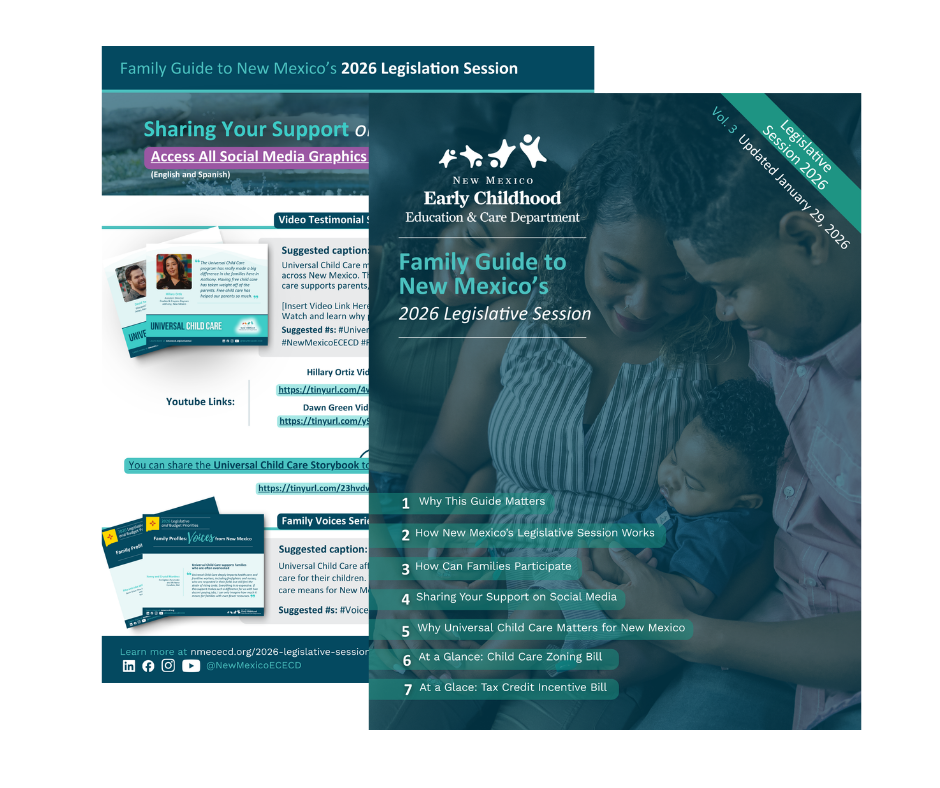
Jan. 20. 2026 Community Legislative Session Spotlight
- Presentation in Spanish │ Download the Spanish accessible PDF
- Presentation in English │Download the English accessible PDF
Feb. 2-3, 2026 Community Legislative Session Spotlight Mid-Way Check In
- Presentation in English │Presentation is accessible
- Presentation in Spanish │Presentation is accessible
Watch: Karen’s Story – Saving for the Future Thanks to Free Child Care
Watch: Hillary’s Story –Growing Her Child Care Business