

Updated: September 10, 2026
What’s Inside?
Sign up to receive weekly updates from ECECD via email!
Reminders/Announcements
You’re Invited: Child Care Assistance Program Act Rulemaking Informational Sessions
The Early Childhood Education and Care Department (ECECD) is hosting virtual office hours to assist with the implementation of the Child Care Assistance Program Act. Spanish translation will be provided at all sessions.
Upcoming Informational Sessions
- Tuesday September 15, 2026, 6–7:15 p.m. – Webinar
- Wednesday September 16, 2026, 6–7:15 p.m. – Family Office Hours
- Thursday September 17, 2026, 12–1:30 p.m. – Provider Office Hours
Zoom link for all sessions: https://nmececdorg.zoom.us/j/85136867599
During the 2026 legislative session, the New Mexico Legislature passed — and Governor Lujan Grisham signed — Senate Bill 241, landmark legislation that codifies the Child Care Assistance Program and establishes Universal Child Care for families working or in school.
Key Highlights of the Child Care Assistance Program Act:
- Codifies Universal Child Care: Ensures long-term program stability and access for families.
- Sustainable Investment: Authorizes up to $700 million in appropriations from the Early Childhood Trust Fund over the next five years.
- Workforce Support: Utilizes a Cost Estimation Model to ensure reimbursement rates reflect the true cost of quality care, including fair compensation for early childhood professionals.
- Transparency and Accountability: Implements new reporting requirements to track program cost, program participation and uptake data, early childhood workforce data, and business structure and operations information.
Join us to learn how these new regulations will be implemented and what they mean for families, providers, and the future of New Mexico’s child care system.
If you are a person with a disability and would like to request accommodations, or a person with limited English proficiency and need interpretation, please contact Maria Spray at Maria.Spray@ececd.nm.gov or 505-670-8993 by 9/11/2026. Please note, Spanish translation will be provided at all sessions.
Loans starting at $100,000 for child care facilities — Applications Now Open
The Child Care Facility Loan Fund offers low-interest, long-term loans for major capital projects: expansion, renovations and repairs, new construction, or operating capital. It’s a partnership between ECECD and the New Mexico Finance Authority.
Why it matters: Financing is one of the hardest barriers to growing child care supply in New Mexico. This fund exists to make affordable capital available to providers ready to make serious investments in their programs.
Who’s eligible:
- Child care providers — individuals, private businesses, nonprofits, and entities owned or managed by tribal governments — who operate or plan to operate licensed home-based or center-based programs
- Employers who want to provide child care for their employees
- Not eligible: entities owned or managed by state or local government, including school districts and charter schools
The details:
- Loans start at $100,000
- Applications opened Tuesday, Sept. 1 at 12 p.m. and close Saturday, Oct. 31 at 5 p.m.
- Incomplete or late applications will not be reviewed
- Funds are limited and applications are scored competitively — bring a detailed, well-planned proposal
Worth knowing: Projects in McKinley, Santa Fe, Sandoval, Lea, Eddy, Bernalillo, and Doña Ana counties earn additional points on the scoring rubric. Loans are open to eligible projects statewide.
What’s next:
- Catch a September info session (join here — note this is a different Zoom link than the Community Call):
- Saturday, Sept. 12, 10–11 a.m.
- Apply, read the FAQ, and find application resources: nmececd.org/childcareloan
- Questions: ECECD.ChildCareLoan@ececd.nm.gov
The Public Education Department wants parents on its Family Cabinet
The New Mexico Public Education Department is accepting applications from parents and guardians who want to shape education policy across the state.
Why it matters: Family advisory bodies work when the families on them reflect the families in the system. That depends on who applies — which depends on who hears about it. Parents of young children are a group that PED hears from less often than it hears from parents of school-age kids, and the transition into kindergarten is exactly where early childhood and K-12 hand off to each other.
Cabinet members connect with other families, provide feedback on department work, and help strengthen family engagement statewide.
Go deeper: Apply for the NM PED Family Cabinet at bit.ly/PED-FamilyCabinet
Sacred Roots, Sovereign Futures moves to November 19–20
Sacred Roots, Sovereign Futures will now convene November 19–20, 2026. Earlier announcements listed September dates; please update your calendars.
The convening brings together Tribal leaders, educators, families, and partners to celebrate partnership, elevate Indigenous knowledge systems, and strengthen pathways for Native children, families, and communities.
Why the date matters: Anyone traveling from a Pueblo or Nation to attend is planning around distance, work, and family. A date change announced with two months of runway is the difference between a rescheduled trip and a missed convening. If you had September blocked, move it now.
What’s next: Venue, registration, and additional details will be announced soon.
If you are a person with a disability and would like to request accommodations, or a person with limited English proficiency and need language access, please email Melanie Valdez, Tribal Systems Alignment Specialist, at Melanie.Valdez@ececd.nm.gov or call 505-637-1898 by November 6, 2026.
September is National Student Parent Month
ECECD recognizes September as National Student Parent Month and marks the statewide launch of the New Mexico Student Parent Alliance.
Parenting students are one of the least visible groups in early childhood. They are counted as students by their colleges and as parents by early childhood systems, and the two rarely coordinate. The result is a family managing a class schedule, a work schedule, and a child care schedule that were each designed without reference to the other two.
The New Mexico Student Parent Alliance (NMSPA) exists to close that coordination gap. It began as a pilot program at Santa Fe Community College and has since launched statewide, with representation from every higher education institution in New Mexico.
NMSPA works from a two-generation approach, meaning the parent’s education and the child’s development are treated as one goal rather than two competing ones. In practice that looks like child care on campus, family-friendly spaces where a student can study with a child present, and direct connection to food, housing, and other resources.
Go deeper: Learn more about the New Mexico Student Parent Alliance
Scholarship and Pay Parity applications moved — your saved link may no longer work
The applications for the ECECD Scholarship and Pay Parity programs have moved to a new online system. Current links and instructions are at ececdscholarship.org.
Why it matters: This is the kind of change that costs people money quietly. An applicant who bookmarked the old form last year gets a page that looks close enough to right, submits, and finds out weeks later that the application never landed. If you have a saved link, replace it before you apply.
What moved and what hasn’t: Scholarship and Pay Parity are the only two applications in the new system right now. Wage Supplement, Bilingual Incentive, and CDA Assessment Voucher applications will move over in phases — keep using your existing process for those three until they do.
Go deeper: View the Scholarship and Pay Incentive Programs flyer or contact the team at ECECD Scholarship and Pay Incentives, info@ececdscholarship.org or 505-224-3232.
Early educators: share your experience, get $100
The Center for the Study of Child Care Employment (CSCCE) at UC Berkeley, in partnership with ECECD, is inviting New Mexico early educators to join focus groups evaluating the Infant Toddler Pay Parity Program.
Why it matters: You don’t have to have participated in the program to participate in the evaluation. CSCCE wants perspectives from educators across the board — and the findings shape how the program evolves.
Who they’re looking for:
- Center directors
- Home-based child care providers
- Center-based lead teachers and assistants
The details:
- When: Through September
- Time commitment: 90 minutes
- Thank-you: $100 Amazon gift card
What’s next: CSCCE will contact directors, home-based providers, and classroom educators directly with scheduling information. Watch your inbox.
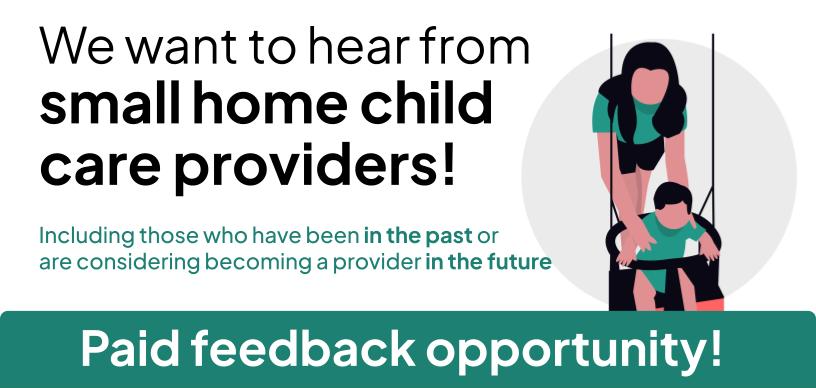
Home child care providers: an $85 paid interview on what starting out is actually like
New America’s New Practice Lab is inviting small home child care providers across New Mexico to a one-hour virtual interview, offered in English or Español.
Why it matters: What gets studied here is the paperwork and the process — how hard it is to start a small home program and become registered with ECECD. Providers who gave up partway through are as useful to this research as providers who finished, which is why former providers and people who only considered it are explicitly included.
Who they’re looking for:
- Current small home providers caring for up to four children who don’t live in the home
- Former small home providers
- Anyone considering becoming a home provider in the future
The details: Sessions are casual and anonymous. Identifiable information stays with the project team and is not shared with New Mexico ECECD. Participants receive an $85 Visa gift card.
Go deeper: Sign up for a New Practice Lab interview at tinyurl.com/ECECD-NPL — questions to NPL-research@newamerica.org.
Events
October Early Childhood Community Call
You’re Invited to participate in September’s Early Childhood Community Call!
Join ECECD Secretary Elizabeth Groginsky and special guests on the first Tuesday of every month from 8–9 a.m., to discuss important issues pertaining to the New Mexico early childhood community.
The next Early Childhood Community Call will be Tuesday, October 6, 2026.
Did you miss the most recent Community Call?
Click here for the recording Passcode: N^8U3^!d (Spanish translation is available under audio settings)
Presentation: September is coming sooon!
Zoom Meeting Details (same link every meeting):
Click here to Join via Zoom
- Telephone: 669-900-9128 or 253-215-8782
- Webinar ID: 958 5783 9577
Individuals who require a disability-related accommodation or language access services to participate in this event are asked to contact ececd-access@ececd.nm.gov at least 10 days in advance of the scheduled meeting.
Professional Development
Coalition Spotlight: Community Partnership for Children
ECECD supports 16 Local Early Childhood System Building Coalitions across 13 counties. Each works to strengthen its community’s ability to deliver high-quality programs and services for children from birth to age 5, advancing New Mexico’s Early Childhood Strategic Plan and ECECD’s five-year plan, Florecer, through community-driven solutions and local-state partnership.
This issue features Community Partnership for Children (CPC), based in Silver City. CPC’s mission is to provide children in need with care, support, and protection, working toward a world where every child grows up happy, healthy, and thriving.
CPC recently launched two portals on its website. A waitlist portal lets families register interest in services that aren’t available yet, so a family who calls when nothing is open leaves a record rather than a dead end. A substitute portal connects programs with qualified substitute educators, which is the difference between a classroom closing for a day and a classroom staying open.
The coalition’s largest contribution has been at the systems level. CPC’s Home Grown Network for Childcare developed a blueprint that was adopted at the state level to help shape ECECD’s registered packet for home-based providers. The blueprint came out of work CPC was already doing on the ground — walking providers through licensing pathways, running training cohorts, setting up Wonderschool, and streamlining documentation.
That origin is the point. Guidance written from the state down tends to assume conditions that hold in Albuquerque and Santa Fe. Guidance built from Grant County outward starts from rural distances, thinner provider networks, and fewer people to ask for help — and a packet that works there works most places.
CPC’s Family Leadership Team spent the last quarter reorganizing and revising community feedback, using it to shape priorities, plan events, and guide outreach.
Go deeper: Visit Community Partnership for Children at grantcountycpc.com
Contact: Kalah Carrasco at cpc@grantcountycpc.com
Live: New Mexico’s Professional Development Information System
New Mexico’s Professional Development Information System (PDIS) is now live. This free online platform centralizes education tracking, credentials, required trainings, and wages for all early childhood professionals.
Enrollment Deadlines
- Wednesday, July 1, 2026: Home Visiting and FIT programs.
Create Your PDIS Profile by clicking this link for the PDIS page on NMECECD’s website.
Support and Accessibility
- Technical Support: Email PDIS-Support@ececd.nm.gov
UNM’s fall CLASS training calendar is open for registration
Registration is open at nmels.org for six fall trainings from the UNM Early Childhood Services Center, most built around CLASS® 2nd Edition.
What’s offered:
- CLASS 2nd Edition Intro to Interactions for Educators — Infant–Toddler and Pre-K–3rd tracks, virtual and in-person
- CLASS 2nd Edition Overview for Leaders — two-hour facilitated online session for program leaders
- CLASS Environment Educator Overview — three-hour self-paced online, Infant–Toddler and Pre-K tracks
- Exploring Motion with Toddlers — in-person, hands-on STEM and language strategies
Worth knowing: The Leaders overview is aligned with the Pre-K–3rd educator training rather than separate from it, so a program leader and their teachers come away with the same vocabulary. Certificates for the CLASS courses are issued through Teachstone.
Go deeper: Register for UNM ECSC fall trainings at nmels.org — questions to nmels@unm.edu.
If you are a person with a disability and would like to request accommodations, or a person with limited English proficiency and need interpretation, please contact David Aldama at daldama@unm.edu or (505) 627-1063.
FOCUS Professional Development substitution: Two college courses now substitute for three FOCUS trainings
New Mexico educators now have the option to substitute certain college courses for three FOCUS training requirements. The substitution provides a path toward higher education while protecting educator time in the classroom.
The substitution
Either of the following college courses may be substituted for three FOCUS trainings:
- Guiding Young Children
- Family and Community Collaboration
Why it matters
The change credits prior coursework that already covers the content of three FOCUS modules — reducing duplicative training time for educators who’ve already learned this material in a college setting and reinforcing the higher-education pathway as a credential-building option.
Next steps
The full FOCUS training substitution flyer lists the eligible courses, the specific FOCUS trainings they substitute for, and the steps to apply the substitution. The flyer is available in English and Spanish.
• View the FOCUS training substitution flyer in English and Spanish
The New Mexico Panic Button: One-tap emergency response for early childhood programs
The Rave Panic Button is a mobile application designed to quickly alert authorities and simultaneously notify all on-site staff of an emergency at an early childhood program.
How it works
When activated, the Panic Button:
- Contacts authorities immediately, providing emergency responders with the program’s location and incident type
- Notifies all staff on-site at the same time, so emergency response protocols can begin without delay
- Reduces response time on both ends — staff coordination is faster, and first responders arrive better informed
Why it matters
In an emergency, the gap between an incident and an organized response is what costs the most — both in safety risk and in cognitive load on staff trying to coordinate while managing children. A single tap collapses that gap.
Learn more